Build Real Software with AI — Not Just Demos
A practical, team-ready approach to modern development using tools like Claude Code, Codex, Cursor, and more.

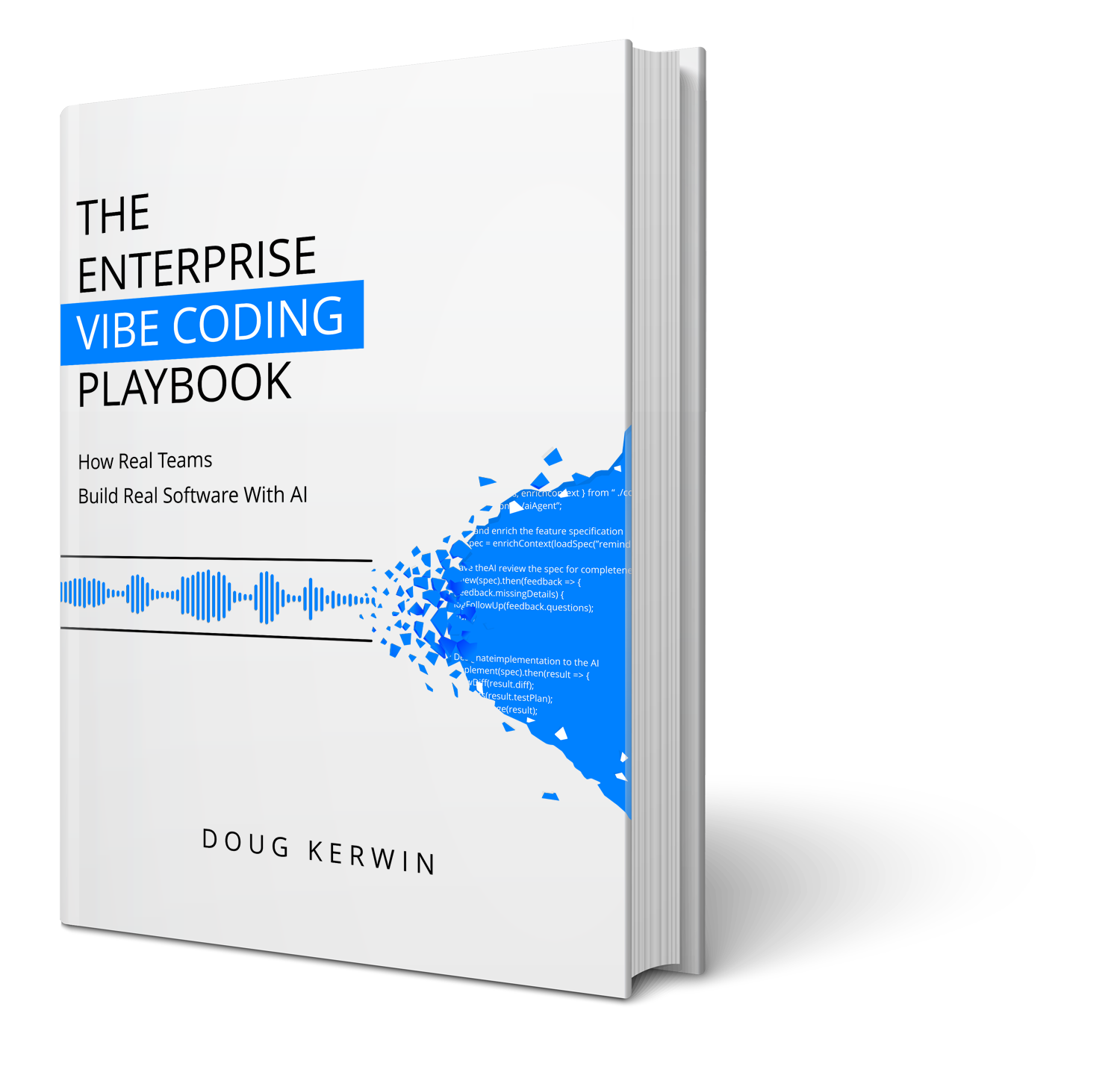
Get the Book
Small teams can build serious software with AI doing the vast majority of the coding. The challenge is making that work reliable and repeatable—in existing systems, with real users, and across a team.
This book is for engineering leaders and experienced developers who want to build serious software with AI—and actually unlock the leverage it offers. It introduces a clear, step by step workflow that makes this approach reliable, repeatable, and scalable.
You'll learn a practical, disciplined approach to building applications—not with AI as a co-pilot, but as the primary developer.
Get The BookWhat People Get Wrong About Vibe Coding
I let AI write nearly all my code—in production apps, every day. But the way "vibe coding" is usually portrayed? That's a problem.
The issue isn't using AI to write code. It's the expectation that you can skip the planning, skip the review, and get magic from a one-shot prompt.
That works for demos. For real products, it creates a mess from commit one.
AI needs structure, clarity, and direction—just like any good developer. Vibe coding can work, but it needs a methodology.
Let's redefine vibe coding — for real work.
I'm not throwing out the idea of vibe coding. I'm evolving it. Real professional vibe coding means:
- Treating AI like a team member, not a magic wand
- Giving it context, structure, and oversight
- Building apps that actually ship — not just demos
- Staying in the loop and managing quality every step of the way
This isn't "prompt once and hope." It's an iterative, intentional process — and it works.
The Enterprise Vibe Coding Method
My method has been battle-tested on real apps — from a HIPAA-compliant health platform built entirely with this approach, to modern microservices and feature expansions integrated into existing production systems. It's structured, teachable, and transformative — even when applied to complex, evolving codebases. Here's a quick preview.
- Direct tools like Claude Code, Codex, and Cursor to do the implementation
- Talk to AI like a collaborator, not a genie
- Define requirements, technical designs, and data models before implementation
- Make good practices repeatable with shared AI instructions, seed projects, and testing workflows
- Review the requirements with a colleague, then verify the implementation against them
Key Principles of the Enterprise Vibe Coding Method
Start with clear requirements and a reviewed technical design
Define what you're building, why it matters, and how you'll know it works. Review the requirements and technical design with a colleague before implementation—the gaps are cheaper to fix there.
Talk to AI like a collaborator, not a genie
Work through the problem together, capture decisions in the project documents, and give the agent enough context to carry the implementation through. Clear requirements let it work autonomously; you remain responsible for the direction and the result.
Use voice to accelerate and preserve depth
Whether you're reviewing code, giving context, or drafting specs — voice lets you express more detail, faster. And when you're in meetings, AI becomes a participant: listening to discussion, drafting stories, and iterating with the team.
Effective use of Git — commit often, reset fast
AI can make sweeping changes quickly. Frequent commits give you the ability to backtrack cleanly when things go sideways.
Verify behavior against the requirements
Passing tests are only useful if they prove the right behavior. Check the acceptance criteria, exercise real integrations, and review the result independently of the agent that built it.
You're the spec writer and reviewer now
Writing code is no longer your primary task. Your job is to guide what gets built and ensure it's built right. Even senior devs need to retrain for this.
The New Mantra
Your role has changed:
You're no longer the hands-on coder.
You're the manager of an AI developer.
Your job is to define the intent, direct the work, and verify the outcome.
That's not just true for junior devs — even senior engineers need to retrain for this shift.
And here's where many teams get it wrong:
This doesn't work if you treat it like a grassroots experiment. You can't just tell your current devs to "start using AI more" and expect transformation. The workflow changes. The expectations change. The entire rhythm of building changes.
You need buy-in at the engineering leadership level — managers, directors, tech leads.
Because the real work has shifted from writing code to writing real, detailed specifications — the kind of specs that product managers and designers often only half-write, and developers used to fill in on the fly.
In traditional workflows:
- Devs figure out the fuzzy parts of a story during implementation
- They make assumptions, build based on them, and hope they're right
- Sprint demo hits, and half the time, it's not what the team wanted
- Then the back-and-forth cycle begins…
That's the inefficiency this method fixes. The shift is from writing code to designing clarity.
If the AI doesn't have a crystal clear picture of what it's building, it will guess. And just like a junior dev, those guesses can derail the whole sprint. With the right mindset, structure, and collaboration, the AI can ship production-grade code. But only if you treat specification as the new development.
This is the work.
This is the method.
And once you see it, you won't want to build any other way.

About Me
I build production systems where essentially 100% of the code is AI-generated—including HIPAA-compliant apps like VillageMetrics. I've been doing this since GitHub Copilot first launched, and I've pushed it much further.
I'm a senior engineering leader with thousands of hours hands-on using AI coding tools to build and ship real systems. I've led cloud engineering at Fortune 500 scale, transformed large monolithic systems into 150+ microservices, and launched generative AI projects in highly regulated environments.
When AI coding tools emerged, I immediately saw the potential and kept pushing to see how far we could take this. I'm an early adopter and daily user of tools like Claude Code, Codex, Cursor, ChatGPT, and WisprFlow—applying them across both startup and enterprise environments.
Work With Me
I work with engineering teams who want to change how software gets built—not just speed up what they're already doing.
Some teams start with training sessions—a focused introduction to the method, the tools, and the mindset shift. That works well for exploration.
But what usually works best is rolling up my sleeves and working hands-on with your team on a real project. We use the method together, I guide the team through it, and by the time we're done, they have the muscle memory to do it on their own next time.
I'm not just trying to help developers work faster—I'm optimizing for organizational leverage.
Whether you're exploring how this fits into your workflow or ready to work together on something real, let's talk.
Tools I use and recommend